
Mobility Lab
Inclusive mobility: how public transport fosters social cohesion
How can we ensure that the transition to more sustainable mobility does not become a source of new disparities? Inclusive mobility guarantees equitable access to transport solutions for all residents of a territory, regardless of their income or abilities. For organizations, it streamlines access to employment and enhances talent retention. For local authorities, it reinforces the acceptability of territorial transformation policies.
This approach is currently transforming urban Europe, demonstrating how territorial innovation generates social equity. Yet when environmental policies minimize social realities, they risk excluding vulnerable populations. In this context, how do cross-border territories reconcile sustainability with inclusion?
Inclusion, a new challenge for European mobility policies
Europe has just grasped the magnitude of a paradox: sustainable mobility policies risk creating new social divisions. This realization is disrupting traditional approaches and forcing metropolitan areas to rethink their transformation strategies.
The catalyst? The European “Social Climate Fund”, which is mobilizing 86.7 billion euros specifically to combat what the European Commission now calls “transport insecurity”¹. This official recognition of a long-ignored phenomenon reflects a new urgency: to reconcile ecological transition and social justice.
However, this political will faces a major challenge. No two European metropolises measure this phenomenon identically. Stockholm is focusing entirely on universal physical accessibility and targeting 100% accessible vehicles for people with reduced mobility (PRM) by 2030². Conversely, Brussels is discovering that its low-emission zones penalize 41% of low-income households despite compensation measures reaching 59% of them³.
This fragmentation reveals the urgent need for coordinated territorial approaches. The canton of Geneva has developed concrete responses in terms of inclusive mobility: full coverage of annual travel passes for young people and 50% for seniors, a social tariff of CHF 66 annually instead of CHF 500 for integration income beneficiaries (SPC) and specific municipal contributions to lighten the financial burden on households.
At the cross-border level, in Greater Geneva where a Swiss resident earns on average 45% more than their French neighbor⁴, this question of equity necessitates multimodal coordination beyond national borders: the harmonization of tariff systems between Swiss and French operators, the coordination of multiple mobility stakeholders, and the creation of service continuity despite administrative fragmentation.
When territorial innovation creates equity
Facing these challenges, certain European metropolises are developing solutions reconciling sustainability with social inclusion. Their contrasting approaches illuminate what genuinely works in practice.
Vienna exemplifies the effectiveness of a direct approach. The Austrian capital has created a social tariff that reduces the monthly cost of public transport by three for low-income populations⁵. This simplicity generates immediate results: 100,000 beneficiaries now have access to the entire metropolitan network with ease. The impact extends beyond mobility: Viennese employers observe improved employment accessibility and reduced absenteeism.
The Dutch experience, on the other hand, reveals the limitations of purely technological approaches. Despite considerable investment in peripheral mobility hubs, merely 15% of residents demonstrate an intention to modify their habits⁶. This resistance stems from the absence of structuring public transport infrastructure capable of linking these new services.
This territorial approach also reveals usage inequalities according to gender. European data shows that 70% of women in the Île-de-France region adapt their public transport journeys owing to perceived insecurity, particularly during off-peak hours⁷. These avoidance strategies combine with complex multimodal journeys linked to family responsibilities, characterizing 25% of daily journeys⁸.
These European lessons converge towards one evident conclusion: organizational innovation takes precedence over technological innovation in generating territorial equity. This lesson guides the approach developed in Greater Geneva, prioritizing cross-border coordination over the proliferation of isolated initiatives.
The 4 pillars of inclusive mobility in Greater Geneva
The cross-border territory structures its response to this reality through four complementary dimensions, transforming geographical and administrative constraints into levers for territorial inclusion.
Financial accessibility, encompassing social pricing and mobility budgets for local authorities. It aims to lower the marginal access cost for vulnerable populations and to harmonize tariffs between Swiss and French operators on the 650,000 daily crossings⁹.
Geographical accessibility, developing peripheral services and feeder solutions towards multimodal hubs. These hubs integrate public transport, bike sharing, carpooling and active mobility to reduce underserved territories.
Universal physical accessibility, concerning people with reduced mobility and families, through adapted facilities (platforms, elevators, ramps), specialized rolling stock, sound beacons and secure spaces. At the canton of Geneva level, two years after the legal deadline set by the LHand, 57%10 of stops now have facilities allowing for independent use or use with assistance. This represents 84%11 of boardings and alightings on the tpg network; this discrepancy is mainly explained by peripheral and rural areas, where the demand for PRM services remains limited. In this context, supporting municipalities meeting standards enables them to prioritize developments according to actual usage.
Information accessibility, coordinating multilingual communication and "end-to-end" support from planning through destination, integrating digital channels and printed materials, in order to reduce cognitive load and enhance the reliability of door-to-door journey choices.
The practical implementation of these 4 pillars relies on structured participatory approaches. This coordination draws notably on the Geneva Mobility General Assembly (180 representatives in 2023) and the ULTIMO project bringing together tpg, the University of Geneva, citizens in co-designing of innovative solutions12. This approach translates concretely into an integrated multimodal system combining public transport, bike sharing, carpooling, active mobility and specialized partnerships according to a coherent territorial vision. For employers, this enhanced multimodality facilitates cross-border recruitment and offers flexible solutions for their teams. For local authorities, it optimizes investments by creating synergies between modes rather than competing initiatives.
Conclusion
Considering these findings, the impact of mobility on social cohesion is measured by the actual access it offers to people and territories, far beyond mere declarations of intent.
Concretely, this inclusion is built through complementarity: social pricing and mobility budgets; services to the peripheries and connections to hubs; universal facilities and adapted services; multilingual information and continuous digital support. In this context, the approach developed by tpg with evomoov, combining collaborative methodology and in-depth territorial knowledge to provide a comprehensive ecosystem of multimodal solutions, enables the support of employers and local authorities in this strategic shift towards territorial inclusion.
To move from intention to action, we invite you to rapidly identify your priority action levers through the tools below. Our evomoov experts remain at your disposal to deepen this assessment and accompany you in your approach.
Measure your potential for territorial inclusion
4-pillar diagnostic: your position in 2 minutes
Assess the inclusive maturity of your organization or local authority
For each pillar, allocate 1, 2, or 3 points according to your current level
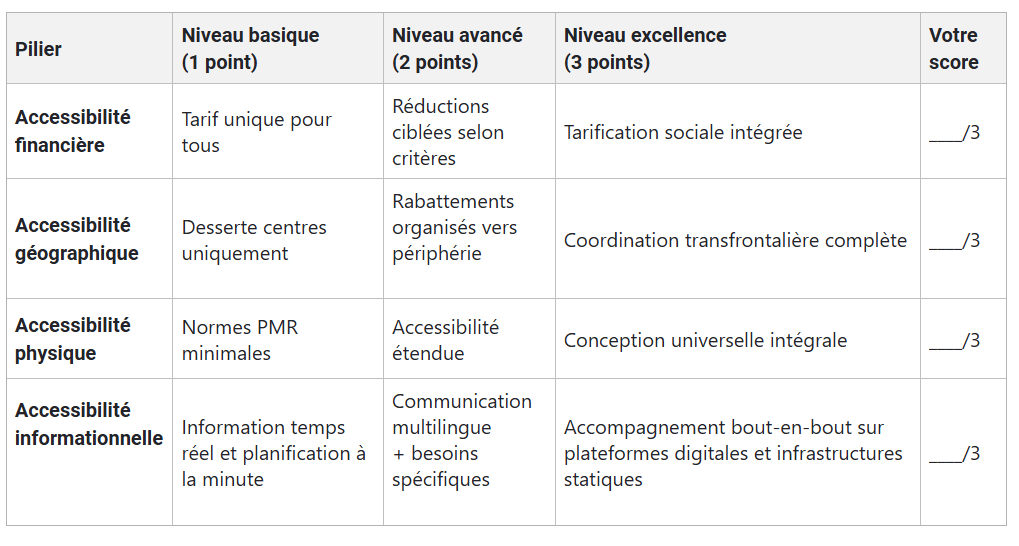
Total score: ___/12
Interpretation of your score:
4-6 points: Risk of territorial exclusion - action required
7-9 points: Significant progress achieved – further optimization possible
10-12 points: Established territorial leadership - capitalize on this advantage
2. Decision support: implementing financial support for mobility
Objective: Determine whether and how your local authority can contribute financially facilitate to access to transport for its residents.
Instructions for use: Review each question below. If you answer "no" or "I don't know" to more than 3 questions, expert guidance is recommended before launching the project.
- Have you defined your priority audiences? (Examples: income below X CHF, single-parent families, residents of underserved areas)
- Do you have clear eligibility criteria? (e.g., accepted supporting documents, validity period, simple renewal procedure)
- Have you estimated the management costs? (e.g., dedicated staff, digital platform, controls, communication)
- Have you anticipated the difficulties? (e.g., stigmatization effect, administrative complexity, potential fraud)
- Have you defined your success indicators? (e.g.,number of users, satisfaction, impact on ridership)
Inspiration: In Vienna, a 65% discounted fare benefits 100,000 people with transparent criteria and simplified management.
Sources and references
¹ Social Climate Fund —Regulation (EU) 2023/955 (official text)
² Trafikanalys (SE) — “Kollektivtrafikens tillgänglighet 2023”
³ IEEP —"Low Emission Zones: Navigating Social Challenges” (2024)
⁴ INSEE & OCSTAT —Cross-border statistical observatory (Greater Geneva)
⁵ City of Vienna (MA40) — Mobilpass (social fare)
⁶ SHAREdiMOBI HUB —Case study (Urban Mobility Observatory)
⁷ Franceinfo — “Seven out of ten women have experienced sexist and sexual violence on public transport in the Île-de-France region” (March 2025)
⁸ EIGE —Gender Equality Index 2023: towards a green transition in transport and energy
⁹ GLCT Grand Genève — “Cross-border mobility roadmap 2024-2027” (PDF)
10 tpg, internal study relating to the tpg network (October 2025)
11tpg, internal study relating to the tpg network (October 2025)
1² Canton of Geneva — “Reconciling users - Geneva Mobility Plan” (General Assembly 2023) and Open Geneva — “The ULTIMO project”